As I began reading Dr. Andrew Huberman’s Protocols, I was struck with the following paragraph. In the Introduction chapter, no less!
“You’ll also notice from just these short few paragraphs that I eschew the whole notion of “biohacking”. A hack is a shortcut that involves leveraging something toward a typically unrelated goal, like jury-rigging a paperclip and tape to fix broken eyeglasses. Hacks are never long-term solutions.”
While Dr. Huberman’s argument is mostly semantic, it does echo a wider culture shift in the health and fitness space I’ve been tracking. So, after over a decade of biohacking, maybe it’s time for me to admit it: biohacking is dead.
Let me show you what happened (and maybe where we are headed).
The whole ‘quantified self’ movement, which predates much of what we now associate with modern health biohacking, embodied (as far as I can tell) a very similar hacker ethos that was developing in the cyber security scene in 80s and 90s. As the name implies, it was very much a data-driven approach to the human body as a system. And like all systems, this one, too, could be optimized, and you can’t improve what you can’t measure.
Hacking was never about shortcuts. It was about systems thinking and creativity.
Don’t believe me?
The Jargon File from the 1970s defines “hacker” as follows:
A person who enjoys learning the details of programming systems and how to stretch their capabilities, as opposed to most users who prefer to learn only the minimum necessary.
and also:
- An expert or enthusiast of any kind. One might be an astronomy hacker, for example.
- One who enjoys the intellectual challenge of creatively overcoming or circumventing limitations.
In general, the term was positive and exploratory. It involved skilled manipulation and deep understanding of systems.
Unfortunately, outside hacker culture, the term eventually became synonymous with malicious computer intrusion often bypassing (=shortcutting) official processes or security systems. I feel biohacking has suffered just as much from that change as it has from the “lifehacking” trend of 2010s (which, to be fair, was mostly about convenience and shortcuts).
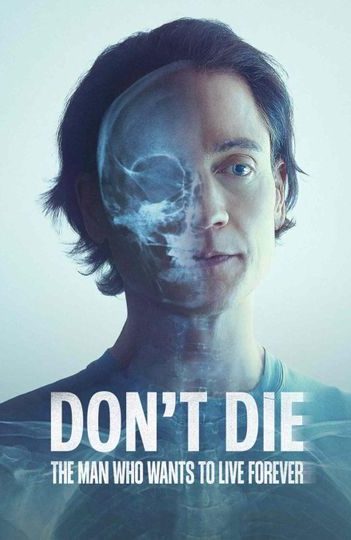
These days, a surprising number if people have some sort of an idea of what biohacking might be, and I bet much of that is thanks to the Netflix documentary Don’t Die, featuring Bryan Johnson’s quest to reverse his aging.
Many would deem Bryan an eccentric character, a weirdo even, when in truth what he does (with his own body and money!) isn’t nearly as out there as grinders (“body hacking” people who insert NFC chips and magnets into their body, for example) or transhumanists in general. Bryan has a very structured, analytical and n=1 science-driven approach to his task. He documents everything and shares his findings for free.
Funnily enough, he calls them protocols, too.
But truly, there’s no better way to visualize the cultural shift than by looking at this promotional photo of the creators of the original Biohacker’s Handbook (and I’m not ashamed to admit I have a signed copy on my bookshelf), who were not just early adopters of the first-generation Oura ring, but as key affiliates and influencers undoubtedly had a massive impact on Oura’s early success during Gen 2 & 3 years.
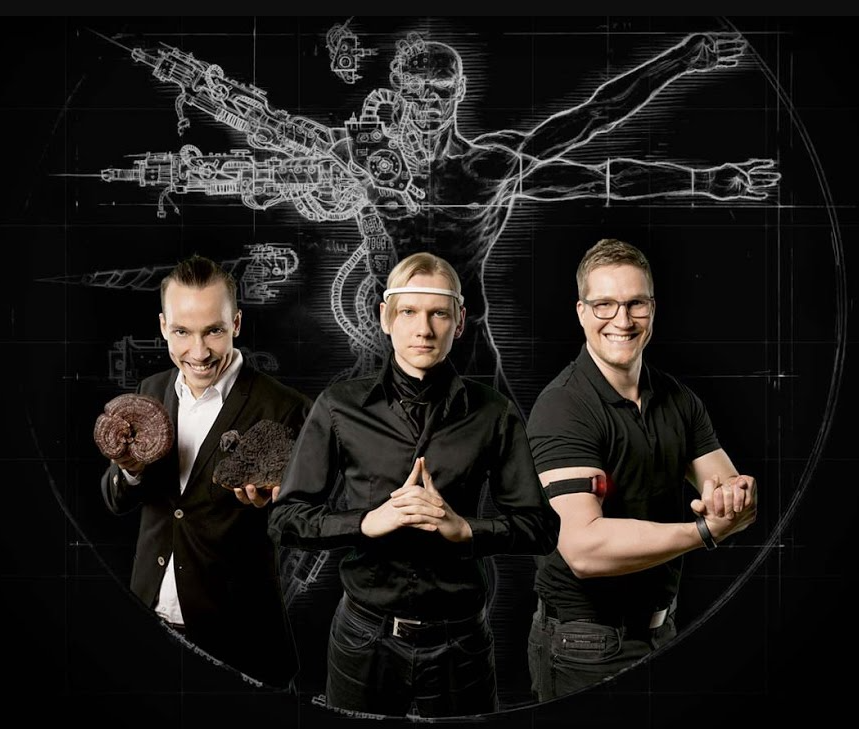
And then compare it to Oura’s current brand imaging:

A similar story can be seen across red light panels, blue-light blocking glasses, barefoot shoes, and so forth. What was once for health nerds is now marketed as (often premium) lifestyle and fitness products. Also notable is the subtle shift of audience focus from men to women.
Somewhere along the way we went from “get some sunlight and track HRV” to “death is an engineering challenge”. And I think the marketers noticed this and were quick to steer the brands away to less niche audiences, and they managed to collectively drag this whole scene with them.
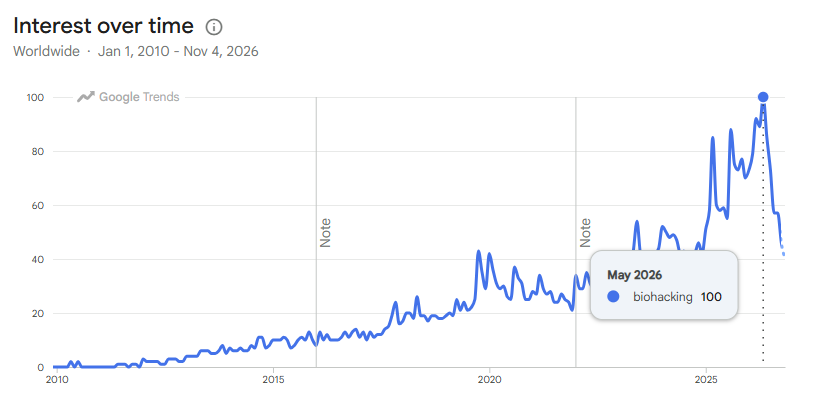
There’s one final datapoint I want to share with you: Google Trends. Again, not substantial by itself, but seems to correlate with everything else I’ve seen. We hit peak biohacking in May 2026. Interest in it has been in sharp decline since.
All that said, I realize I’m like Edward Bernays when he wrote a whole book complaining that the term “propaganda” was misunderstood and had lost its original meaning. That is to say, my complaint is the intellectual (and useless) equivalent of “old man yells at cloud”.
Language evolves, for better or worse.
So far, much of what I’ve read from Protocols has been common knowledge in our biohacking circles for years, but I am glad to see the message reaching a wider mainstream audience. If his book would’ve been published a decade ago, it would’ve been considered a biohacking book. The whole opening about circadian rhythm is right up “our” alley.
Maybe the nerdy health subculture grew up, or maybe it just got absorbed into the wider fitness boom of 2020s. Whatever the case may be, biohacking succeeded itself out of existence.
I guess the question becomes then: what should people interested in these things call themselves, if not biohackers?
“Protocollers” doesn’t quite have the ring to it.


