This is a follow-up to my popular Using Grok AI for X OSINT article from last year. A lot can happen in the LLM space in a year, so now I’m renewing by X account analysis efforts with the latest tools:
- Premium X subscription
- Grok Bot 0.79.3 desktop with
- X connector (100/100 tools enabled, x-mcp-guide skill in use)
- A dedicated AI agent (one Grok Bot in my current team of seven)
Instead of manually prompting to evaluate individual X users, this time I took into crosshairs my own account and all 1,174 of my followers. This is also possible to do without paying for API (but more on that later). The question I wanted to answer was
How many of my followers are bots?
Before jumping into my methodology and results, one important clarification on the terminology. A “bot” is my catch-all term for automated accounts, fake-but-manual accounts (honey trap personas, scams, impersonation, and so forth), and spam accounts (often used once or for a short period of time for giveaways or referral link spam). I know, not ideal, but that’s how the word is used these days.
In fact, this very thing cause a lot of confusion recently as Cloudflare showed Russian “bot traffic” dropping drastically after Ukraine drone strikes hit Yandex datacenters. I did my part of correcting the misinformation by giving interviews to Yle News and MTV News.
Using Grok’s data analysis to detect bots wasn’t as watertight as I had hoped, so I included manual review in the process as well. Here’s what I found out.
Scoring method and human-in-the-loop calibration
Grok’s first pass through all my followers gave me already some useful information. Each account was scored on seven signals, summing to 100:
- account age 15
- followers/following ratio 20
- post count 15
- default avatar 15
- empty bio 10
- name+digits handle 15
- creation-date clustering 10
Initial results: median 7.7, max 70.5, 90th percentile 39.0, with 111 accounts above it.
This seemed quite a lot, so I begun the first manual review. I annotated 52 accounts, out of which 19 I declared bots and 28 legit (some of them I couldn’t be sure, so I rated them “trending bot/legit”, and trending verdict is counted as half).
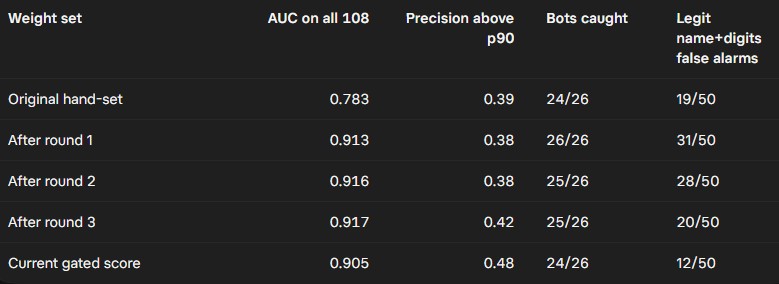
Unsurprisingly this first calibration had a big positive impact on AUC. Second and third reviews barely moved AUC on the same labels. What they did was reduce false alarms on ordinary “name+digits” handles (more on this below), which round 1 had made worse.
Here’s how the model’s accuracy looked like after each review:
Three signals I saw but the model didn’t
One of the most obvious signs of a bot account is the “name+digits” handle. Nearly every bot detected by the model and my manual review shared that pattern. However, so did a lot of the legitimate accounts I manually reviewed. As this is the default handle style of Twitter/X, it alone could not be used as a strong indicator of “botness”. So I made it conditional: the handle only counts once another red flag is already present. That cut false alarms among real “name+digits” accounts in the top slice from 20 to 12 out of 50, raised precision from 0.42 to 0.48, and cost one missed bot. AUC barely moved. The gain was in which accounts land at the top, not in the overall ranking.
Second, as I am Finnish, I have a lot of Finnish followers too. Grok struggled to detect this even when the user name was like “Matti Meikäläinen” and handle “@mattimeikalainen”. Many of these accounts had also been inactive for a long time, which Grok initially thought suspicious.
Third, contextual and especially visual judgement is still human work. At least without additional tools, Grok couldn’t, for example, analyze profile images to detect honeytraps.
There were some other smaller signals too, like birth year (in name or bio) that didn’t match the handle, using exclusively different language than what was revealed as the account’s location by X-Posed browser plugin.
Linking method and findings
First, the answer to my original research question:
26 out of 1,174 followers are confirmed bots or fakes. Grok’s best estimate (“moderately certain”) is 5-7% total, so roughly 60-85 accounts.
Of course further manual reviews could make these numbers more accurate. Still a far cry of the bot creation waves of 2023 (screenshotted examples here and here).
I also wanted to see if I could link these bots together i.e. were they created together for whatever influence purpose. For this I asked Grok to look for typical patterns:
- creation within ±1 or ±3 days
- same handle template
- avatar URL or hash
- bio similarity
- near-identical posts
- identical retweets
- posting-hour profile
- and, added later, posts within 2 minutes of each other and the same 6-word opening.
The result was 5 strong links, giving 5 pairs. Two of the accounts I labeled in the manual review as bots without knowing the link! But in general, it’s safe to say this cursory overview didn’t find evidence of a coordinated network behind my followers. The bots look opportunistic and independent.
True link analysis with follower graphs of other accounts and likes are the big blind spots. These would require paying for X API, which I might do in the future. This would also enable cluster visualizations beyond just 1st degree connections.
Ethics and GDPR
- Scope: only the public profile data of the author’s own followers. Collection, storage and processing happen on a single machine, with no third-party analytics.
- Data minimization: posts are stored as id, text and timestamp only; avatars are hashed, never stored; likes were not collected.
- Storage limitation: raw data is deleted 30 days after publication, and only aggregate or anonymized results are kept.
- Publication: no handles or names, anonymized map labels, blurred screenshots.
- Purpose limitation: the data is used for this analysis only. It is not used for reporting accounts or for profiling individuals.
- Note that “bot” verdicts on individuals are judgements, not facts.


